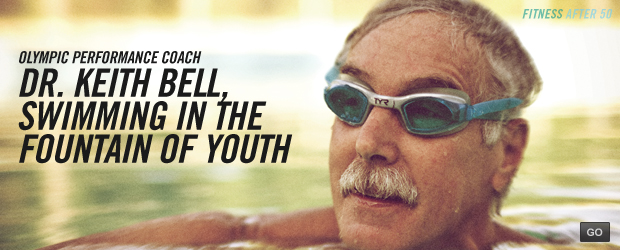
Dr. Keith Bell: Swimming in the Fountain of Youth
Breathe in, breathe out.
Focus on the stroke.
Right…left. Right…left.
Stay steady and keep pushing.
Get ready to flip.
Now turn.
Day in and day out, for no less than an hour at a time, this is the abbreviated routine Dr. Keith Bell puts his mind and body through, slicing through the tepid lap pool at Deep Eddy off Lake Austin Blvd. Amazingly enough, this world-renowned sports performance expert and local swimming icon has been doing it every day for as far back as he can remember.
“Okay, I think I missed a day in the 80s,” he sheepishly admits. The crazy thing is that he’s not joking.
Whatever you want to call Bell’s quotidian fitness routine (as he often refers to it), over the years it’s become more than a superstitious streak or a lesson in raw willpower. In many ways, swimming is the daily ritual that has come to define him.
“I guess you might call swimming every day for more than 20 years a fitness accomplishment, but I don't really think of fitness in terms of accomplishments,” he says. “Swimming is just a given part of my day – I eat, sleep, drink and swim every day. It's part of what I do to stay alive, healthy and fit.”
In fact, about 10 years ago when Bell underwent knee surgery, his doctors implored him to take a rest from his favorite water activity. As he humorously recounts it, they should have known who they were dealing with. Then maybe they would have realized the futility of their request.
“I just couldn’t miss a day,” he recalls. “I swam the morning right before my surgery and was back in the pool the next day. Swimming was so much better for my body and my recovery than sitting around in a chair or laying with my leg propped up all day.”
When Bell returned for his check-up just 10 days post-surgery, his doctors were amazed by the quick recuperation. A week earlier, what had been a bruised and stitched-up leg, was now a pristine, healthy-looking limb. Everything was healing faster than the doctors, or Bell, could have imagined.
“After seeing my leg, they joked that all future patients were going to the pool right after surgery,” he says.
In His Element
A few years ago, we had the chance to visit with Bell in his home, meet his extraordinary wife Sandy Neilsen Bell (a three-time Olympic gold medalist herself, by the age of 16) and learn more about the man widely considered to be one of swimming’s most influential sports psychologists.
Bell’s easy-going personality and soothing, soft-spoken demeanor instantly took us by surprise, as did his almost mystifying youthfulness. Just shy of 60 at the time, he barely looked to be in his 40s, yet his résumé of professional accomplishments read like a novel.
Having coached some 400 teams and more than 15,000 athletes in his career, Bell also has published nine books on sports psychology and consulted with half a dozen Olympic swim teams on ways to win, both in and out of the pool. Without question, he is the foremost expert on how to keep elite swimmers pushing themselves in their sport, both mentally and physically…and to have fun doing it.
“Although I've always enjoyed it, I've become extremely skilled at making training fun,” he says.
We definitely caught a glimpse of this during our first meeting, but it wasn’t until we met up with Bell a few weeks ago at his second home — the Deep Eddy pool — where we got to see his training style firsthand. This time around he wasn’t coaching a local athlete or a master’s swim team; he was applying years of expertise to his own daily routine.
“When I decided to swim for health and fitness, I decided that if I was going to swim, I was going to make it fun,” he says. “Keeping it fun makes it easy to stay consistent. For me, swimming is just a wonderful part of each day.”
Watching Bell dive in with flawless form, gliding effortlessly through the water lap after lap and rarely taking a break, we realized why he was the first man over age 45 to ever place in a USS National Championship. It also hinted as to why he still looks so young.
As he spryly popped out of the pool, the conversation immediately turned to his favorite pastime; the one subject Bell has no problem talking about, writing about or for that matter, doing. Yes, you guessed it: swimming.
“Well, it’s not a secret, but my philosophy of life is: You can't let working for a living get in the way of your swimming,” he says. “Swimming just does the trick, and for me, competitive swimming is huge. By setting and striving to attain challenging competitive goals and setting and striving to attain training goals in order to reach my competitive goals, I stay significantly more fit.”
As we learned that day, one of Bell’s more competitive goals is a mind-boggling birthday present to himself.
“Every year I swim my age in 100s,” he explains rather dryly. “My son flies in and a bunch of friends come and join me and the family.”
Yes, you read that right. Having just turned 62 last month, Bell spent his most recent birthday swimming more than 180 laps in the Deep Eddy pool. All in about an hour and half no less.
“I guess there are times when my swimming takes me away from my family, but it’s often the other way around,” he says. “Swimming is something we do together. I believe that one of the best gifts you can give your children is a healthy parent.”
So, after all his years of coaching, training and probing the athletic mind, could spending just a few hours in the pool every day be the closest thing to a real fountain of youth? Bell doesn’t seem to flinch at the thought.
“Health is definitely a high priority, and fortunately swimming is my passion and my lifeblood,” he says. “I don't think anything is better for health than swimming.”
What does your exercise routine look like? When I roll out of bed each morning, I hit the carpet and do at least 100 push-ups and at least 20 crunches in six different positions, plus a little bit of stretching. Depending on how my shoulder is doing, I do pull-ups on a bar that hangs above a staircase outside my office. I lift weights and do stretch cords three times per week. This last year, I've also taken up kayaking, and of course, I swim every day.
What does your swim routine consist of? These days I usually warm up with a fairly long swim, because at my age, it takes awhile to get my body to stop creaking when I move. Then, I like to do some variation of the practice I give the TeamTexas Masters Swim Team, which my wife, Sandy, and I coach. I probably average swimming somewhere between 2.5 to 5 miles per day. When the water temperature in Lake Travis is okay (anywhere between 60 and 78 degrees), I've been doing fairly long (60- to 150-minute) swims in Lake Travis. Right now, the water in the lake it is way too hot, so I'm only swimming in the pool.
How often do you rest? I tell myself to rest one or two days per week. On those days, I'll go swim with the intention of only swimming an easy 2,000 to 3,000 yards. Unfortunately, I'm not very good at that. In spite of good intentions, the 2 to 3K swim usually ends up being a 4 to 6K and I often end up getting after it. I just choose to keep going and get after it because I'm enjoying it too much. I know I need the rest, but I love it. I don’t want to get out of the water.
Anything else you do to stay in shape? I almost always take the stairs instead of elevators. I run up my (very steep) driveway to get the morning paper and jog back down. I park at the far end of the parking lot and run to and from the grocery store. I also run from my car to the pool to coach. You get the idea.
How’s healthy is your diet? I haven't eaten pork or beef for about 30 years now. Over the years, I've gradually tapered off of fried foods until I hardly ever eat any (though I confess to some French fries once in awhile). A couple of years ago I started reading labels more carefully and stopped eating anything with high fructose corn syrup in it. And, I hardly ever eat any refined sugar. Right now, I'm working on eating more often (which I seem to need to do), I've upped my consumption of good oils, nuts, and avocados and I’m working on a lower glycemic index diet. I'm also hydrating more often than ever before.
How do you manage stress? I don't do stress. I exercise, laugh, enjoy life, relax and strive to take the late William F. Buckley Jr.'s advice to "maintain a modicum of imperturbability." Sometimes I make noise as if I'm stressing, but I'm generally pretty calm underneath it all. When nothing else works, I swim. Even if it does work, I swim.
How often do you go to the doctor? Rarely in the last 40 years and now, almost all of the doctors I've had have retired. I did have a check-up two years ago at age 60 and again a couple of weeks ago.
What are three things you miss from your youth, as it relates to health and fitness? I miss playing baseball. I love baseball. If I have any regrets in life, one of them might be that it never occurred to me to walk on to the baseball team in college after swim season was over. It’s been years since I’ve even played City League slow pitch softball. I also miss running. [Bell stopped after knee surgery in his early 50s.] Finally, I miss playing touch football and the reckless abandon with which I did things at a younger age.
What are three things you do better now, as it relates to health and fitness? I've become extremely skilled at making training fun, I've become better at training alone and without a doubt, I eat better.
In terms of your fitness, how do you feel you compare to others your age? Are there others as old as I am? Well, as a sports psychologist, I often speak to swimmers about the fact that they (even those who are only a few months into the sport) swim faster than 99+ percent of the population of the world. Similarly, I suspect that I am, as are just about all competitive swimmers, most competitive athletes, and, perhaps, many of your readers, more fit than 99+ percent of the population of the world.
Finally, what are some of your secrets to staying fit after age 50? As you know, I swim every day. The last time I missed a day was sometime in the 1980s. I don’t necessarily think everyone should do that by the way, as rest days are important. But I just like being in the water and training. So, my rest days (when I manage to do them) consist of less effort and less distance. Of course, in addition to my quotidian swim, I do much of what is usually recommended. I do some weight lifting, I eat salutary foods. I do zero drugs — no alcohol, no tobacco and no caffeine. Plus, I avoid anyone who is, and anywhere anyone is, smoking. I do pretty well at consistently getting to bed at a reasonable hour and waking up at approximately the same time every day. Overall, I believe consistency plays a large part in success.
Winning Isn’t Normal
by Dr. Keith Bell
This is an excerpt from Dr. Keith Bell’s most famous book, “Winning Isn’t Normal,” which was recently made into a motivational poster. It not only gives you a peek into Bell’s training philosophy, but why he’s been so successful in staying fit after 50. Which unfortunately, isn’t so normal these days.
"Winning isn’t normal. That doesn’t mean there’s anything wrong with winning. It just isn’t the norm. It’s highly unusual."
"Every race only has one winner. No matter how many people are entered, only one person, or one team, wins."
"Winning is unusual. As such, it requires unusual action."
"In order to win, you must do extraordinary things. You can’t just be one of the crowd. The crowd doesn’t win. You have to be willing to stand out and act differently."
"Your actions need to reflect unusual values and priorities. You have to value success more than others do. You have to want it more. (Now take note! Wanting it more is a decision you make and act upon – not some inherent quality or burning inner drive or inspiration!) And you have to make that value a priority."
"You can’t train like everyone else. You have to train more and train better."
"You can’t talk like everyone else. You can’t think like everyone else. You can’t be too willing to join the crowd, to do what is expected, to act in a socially accepted manner, to do what’s in. You need to be willing to stand out in the crowd and consistently take exceptional action. If you want to win, you need to accept the risks and perhaps the loneliness…because winning isn’t normal!"
©copyright Dr. Keith Bell
Focus on the stroke.
Right…left. Right…left.
Stay steady and keep pushing.
Get ready to flip.
Now turn.
Day in and day out, for no less than an hour at a time, this is the abbreviated routine Dr. Keith Bell puts his mind and body through, slicing through the tepid lap pool at Deep Eddy off Lake Austin Blvd. Amazingly enough, this world-renowned sports performance expert and local swimming icon has been doing it every day for as far back as he can remember.
“Okay, I think I missed a day in the 80s,” he sheepishly admits. The crazy thing is that he’s not joking.
Whatever you want to call Bell’s quotidian fitness routine (as he often refers to it), over the years it’s become more than a superstitious streak or a lesson in raw willpower. In many ways, swimming is the daily ritual that has come to define him.
“I guess you might call swimming every day for more than 20 years a fitness accomplishment, but I don't really think of fitness in terms of accomplishments,” he says. “Swimming is just a given part of my day – I eat, sleep, drink and swim every day. It's part of what I do to stay alive, healthy and fit.”
In fact, about 10 years ago when Bell underwent knee surgery, his doctors implored him to take a rest from his favorite water activity. As he humorously recounts it, they should have known who they were dealing with. Then maybe they would have realized the futility of their request.
“I just couldn’t miss a day,” he recalls. “I swam the morning right before my surgery and was back in the pool the next day. Swimming was so much better for my body and my recovery than sitting around in a chair or laying with my leg propped up all day.”
When Bell returned for his check-up just 10 days post-surgery, his doctors were amazed by the quick recuperation. A week earlier, what had been a bruised and stitched-up leg, was now a pristine, healthy-looking limb. Everything was healing faster than the doctors, or Bell, could have imagined.
“After seeing my leg, they joked that all future patients were going to the pool right after surgery,” he says.
In His Element
A few years ago, we had the chance to visit with Bell in his home, meet his extraordinary wife Sandy Neilsen Bell (a three-time Olympic gold medalist herself, by the age of 16) and learn more about the man widely considered to be one of swimming’s most influential sports psychologists.
Bell’s easy-going personality and soothing, soft-spoken demeanor instantly took us by surprise, as did his almost mystifying youthfulness. Just shy of 60 at the time, he barely looked to be in his 40s, yet his résumé of professional accomplishments read like a novel.
Having coached some 400 teams and more than 15,000 athletes in his career, Bell also has published nine books on sports psychology and consulted with half a dozen Olympic swim teams on ways to win, both in and out of the pool. Without question, he is the foremost expert on how to keep elite swimmers pushing themselves in their sport, both mentally and physically…and to have fun doing it.
“Although I've always enjoyed it, I've become extremely skilled at making training fun,” he says.
We definitely caught a glimpse of this during our first meeting, but it wasn’t until we met up with Bell a few weeks ago at his second home — the Deep Eddy pool — where we got to see his training style firsthand. This time around he wasn’t coaching a local athlete or a master’s swim team; he was applying years of expertise to his own daily routine.
“When I decided to swim for health and fitness, I decided that if I was going to swim, I was going to make it fun,” he says. “Keeping it fun makes it easy to stay consistent. For me, swimming is just a wonderful part of each day.”
Watching Bell dive in with flawless form, gliding effortlessly through the water lap after lap and rarely taking a break, we realized why he was the first man over age 45 to ever place in a USS National Championship. It also hinted as to why he still looks so young.
As he spryly popped out of the pool, the conversation immediately turned to his favorite pastime; the one subject Bell has no problem talking about, writing about or for that matter, doing. Yes, you guessed it: swimming.
“Well, it’s not a secret, but my philosophy of life is: You can't let working for a living get in the way of your swimming,” he says. “Swimming just does the trick, and for me, competitive swimming is huge. By setting and striving to attain challenging competitive goals and setting and striving to attain training goals in order to reach my competitive goals, I stay significantly more fit.”
As we learned that day, one of Bell’s more competitive goals is a mind-boggling birthday present to himself.
“Every year I swim my age in 100s,” he explains rather dryly. “My son flies in and a bunch of friends come and join me and the family.”
Yes, you read that right. Having just turned 62 last month, Bell spent his most recent birthday swimming more than 180 laps in the Deep Eddy pool. All in about an hour and half no less.
“I guess there are times when my swimming takes me away from my family, but it’s often the other way around,” he says. “Swimming is something we do together. I believe that one of the best gifts you can give your children is a healthy parent.”
So, after all his years of coaching, training and probing the athletic mind, could spending just a few hours in the pool every day be the closest thing to a real fountain of youth? Bell doesn’t seem to flinch at the thought.
“Health is definitely a high priority, and fortunately swimming is my passion and my lifeblood,” he says. “I don't think anything is better for health than swimming.”
Q&A
What does your exercise routine look like? When I roll out of bed each morning, I hit the carpet and do at least 100 push-ups and at least 20 crunches in six different positions, plus a little bit of stretching. Depending on how my shoulder is doing, I do pull-ups on a bar that hangs above a staircase outside my office. I lift weights and do stretch cords three times per week. This last year, I've also taken up kayaking, and of course, I swim every day.
What does your swim routine consist of? These days I usually warm up with a fairly long swim, because at my age, it takes awhile to get my body to stop creaking when I move. Then, I like to do some variation of the practice I give the TeamTexas Masters Swim Team, which my wife, Sandy, and I coach. I probably average swimming somewhere between 2.5 to 5 miles per day. When the water temperature in Lake Travis is okay (anywhere between 60 and 78 degrees), I've been doing fairly long (60- to 150-minute) swims in Lake Travis. Right now, the water in the lake it is way too hot, so I'm only swimming in the pool.
How often do you rest? I tell myself to rest one or two days per week. On those days, I'll go swim with the intention of only swimming an easy 2,000 to 3,000 yards. Unfortunately, I'm not very good at that. In spite of good intentions, the 2 to 3K swim usually ends up being a 4 to 6K and I often end up getting after it. I just choose to keep going and get after it because I'm enjoying it too much. I know I need the rest, but I love it. I don’t want to get out of the water.
Anything else you do to stay in shape? I almost always take the stairs instead of elevators. I run up my (very steep) driveway to get the morning paper and jog back down. I park at the far end of the parking lot and run to and from the grocery store. I also run from my car to the pool to coach. You get the idea.
How’s healthy is your diet? I haven't eaten pork or beef for about 30 years now. Over the years, I've gradually tapered off of fried foods until I hardly ever eat any (though I confess to some French fries once in awhile). A couple of years ago I started reading labels more carefully and stopped eating anything with high fructose corn syrup in it. And, I hardly ever eat any refined sugar. Right now, I'm working on eating more often (which I seem to need to do), I've upped my consumption of good oils, nuts, and avocados and I’m working on a lower glycemic index diet. I'm also hydrating more often than ever before.
How do you manage stress? I don't do stress. I exercise, laugh, enjoy life, relax and strive to take the late William F. Buckley Jr.'s advice to "maintain a modicum of imperturbability." Sometimes I make noise as if I'm stressing, but I'm generally pretty calm underneath it all. When nothing else works, I swim. Even if it does work, I swim.
How often do you go to the doctor? Rarely in the last 40 years and now, almost all of the doctors I've had have retired. I did have a check-up two years ago at age 60 and again a couple of weeks ago.
What are three things you miss from your youth, as it relates to health and fitness? I miss playing baseball. I love baseball. If I have any regrets in life, one of them might be that it never occurred to me to walk on to the baseball team in college after swim season was over. It’s been years since I’ve even played City League slow pitch softball. I also miss running. [Bell stopped after knee surgery in his early 50s.] Finally, I miss playing touch football and the reckless abandon with which I did things at a younger age.
What are three things you do better now, as it relates to health and fitness? I've become extremely skilled at making training fun, I've become better at training alone and without a doubt, I eat better.
In terms of your fitness, how do you feel you compare to others your age? Are there others as old as I am? Well, as a sports psychologist, I often speak to swimmers about the fact that they (even those who are only a few months into the sport) swim faster than 99+ percent of the population of the world. Similarly, I suspect that I am, as are just about all competitive swimmers, most competitive athletes, and, perhaps, many of your readers, more fit than 99+ percent of the population of the world.
Finally, what are some of your secrets to staying fit after age 50? As you know, I swim every day. The last time I missed a day was sometime in the 1980s. I don’t necessarily think everyone should do that by the way, as rest days are important. But I just like being in the water and training. So, my rest days (when I manage to do them) consist of less effort and less distance. Of course, in addition to my quotidian swim, I do much of what is usually recommended. I do some weight lifting, I eat salutary foods. I do zero drugs — no alcohol, no tobacco and no caffeine. Plus, I avoid anyone who is, and anywhere anyone is, smoking. I do pretty well at consistently getting to bed at a reasonable hour and waking up at approximately the same time every day. Overall, I believe consistency plays a large part in success.
Dr. Keith's Book
Winning Isn’t Normal
by Dr. Keith Bell
This is an excerpt from Dr. Keith Bell’s most famous book, “Winning Isn’t Normal,” which was recently made into a motivational poster. It not only gives you a peek into Bell’s training philosophy, but why he’s been so successful in staying fit after 50. Which unfortunately, isn’t so normal these days.
"Winning isn’t normal. That doesn’t mean there’s anything wrong with winning. It just isn’t the norm. It’s highly unusual."
"Every race only has one winner. No matter how many people are entered, only one person, or one team, wins."
"Winning is unusual. As such, it requires unusual action."
"In order to win, you must do extraordinary things. You can’t just be one of the crowd. The crowd doesn’t win. You have to be willing to stand out and act differently."
"Your actions need to reflect unusual values and priorities. You have to value success more than others do. You have to want it more. (Now take note! Wanting it more is a decision you make and act upon – not some inherent quality or burning inner drive or inspiration!) And you have to make that value a priority."
"You can’t train like everyone else. You have to train more and train better."
"You can’t talk like everyone else. You can’t think like everyone else. You can’t be too willing to join the crowd, to do what is expected, to act in a socially accepted manner, to do what’s in. You need to be willing to stand out in the crowd and consistently take exceptional action. If you want to win, you need to accept the risks and perhaps the loneliness…because winning isn’t normal!"
©copyright Dr. Keith Bell
Fairway to Fitness, June 2009 Issue
Austin's 10 Fittest, August 2009 Issue
Get Stoked to Get Soaked: 15 Austin Lake Activities, May 2009 Issue